How often does the power go out in Fairfax County, VA?
In 2025, the average electricity customer in Fairfax County went about 4 h 28 min without power, spread over 1.6 outages. That is our estimate from the reliability figures the 2 utilities serving the county filed with the U.S. Energy Information Administration. about average
How Fairfax County compares
A customer in Fairfax County spent 40% less than the Virginia average of 7 h 26 min without power in 2025, and about the same as the U.S. average of 4 h 23 min. Among the 126 ranked counties in Virginia it was the 6th most reliable. Nationally it ranks 1,377th of 2,784.
When the power did go out, it stayed out for about 2 h 47 min on average (outage minutes divided by the number of outages). Most of the year's outage time, about 53%, came on "major event days": storms and other days so bad they fall outside the utility's normal statistics. Without those days, customers would have been in the dark for 2 h 6 min.
2025 was close to the county's five-year average of 4 h 11 min a year. Outage time jumps around from year to year with the weather, so the five-year figure is the better guide to what to expect.
On our reading guide, which compares each place with the U.S. average for the same year, Fairfax County counts as about average: outage time close to the national figure.
Utilities serving Fairfax County
The EIA's 2025 service territory file lists 2 utilities delivering power in Fairfax County. We estimate Virginia Electric & Power Co serves the largest share of customers here (about 82%). Your own outage experience depends on which one sends your bill and on your street.
| Utility | Est. share of customers | Outage time | Outages |
|---|---|---|---|
| Virginia Electric & Power Co | 82% | 5 h 7 min | 1.78 |
| Northern Virginia Elec Coop | 18% | 1 h 34 min | 0.98 |
Outage time = SAIDI, outages = SAIFI, both including major event days, as filed by each utility for its whole Virginia service area (not just this county). Customer shares are our estimate: each utility's Virginia customers spread across the counties it serves by population.
Major grid emergencies in Virginia
Utilities and grid operators must report big disturbances to the Department of Energy on Form OE-417. From 2016 to 2025, 52 reports named Virginia; 34 of them were weather-related and 31 cut power to 50,000 or more customers. The largest by customers affected:
- 08/04/2020: Severe Weather, 508,000 customers
- 03/03/2023: Severe Weather, 346,000 customers (report covered several states)
- 03/25/2023: Severe Weather, 160,801 customers (report covered several states)
Counts include multi-state reports. Customer numbers are as reported; see Virginia for the year-by-year count.
What it takes to ride out an outage here
For an average Fairfax County outage of 2 h 47 min, keeping a refrigerator, a laptop and a ceiling fan running takes about 1,300 Wh, so a power station rated for about 1,530 Wh covers it once inverter losses are allowed for. A full day of the same takes about 8,824 Wh of battery, or a generator rated for at least 1,188 running and 2,400 starting watts (the refrigerator compressor needs a surge to start). Work out your own list in the backup power calculator.
Run generators outdoors only, well away from doors, windows and vents, and keep a battery-backed carbon monoxide alarm inside. Never plug a generator into a wall outlet. See Ready.gov's power outage guidance. For an outage happening now, check your utility's outage map.
Backup power for outages like these
As an Amazon Associate I earn from qualifying purchases. We have not tested these products; they are examples of each size class. Check the specifications against the calculator.
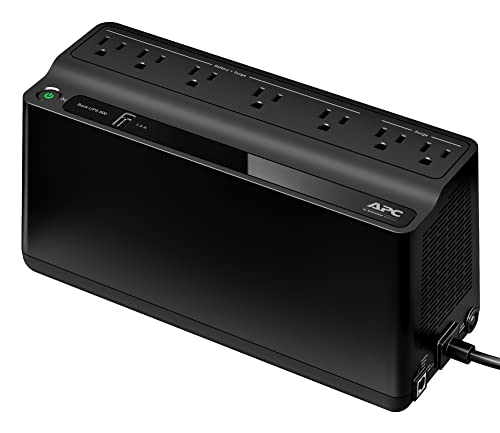
APC UPS Battery Backup & Surge Protector BE600M1
Keeps a modem and router (or a desktop computer) running through short outages and blips.
Check price on Amazon
EF ECOFLOW Delta 2 Portable Power Station, 1024Wh 1800W
About 1 kWh with an 1,800 W inverter: a refrigerator for most of a day.
Check price on Amazon
Jackery Explorer 1000 v2 Portable Power Station, 1024Wh
The same 1 kWh class from Jackery.
Check price on Amazon
BLUETTI AC180 Portable Power Station, 1152Wh 1800W
A slightly larger 1.15 kWh battery with an 1,800 W inverter.
Check price on Amazon
Honda EU2200i 2200 Watt Inverter Generator
Quiet 2,200 W inverter generator: a fridge, lights and a power station charger. Outdoors only.
Check price on AmazonCarbon monoxide alarm with battery backup
Essential before running any generator: generator exhaust can kill within minutes indoors or near windows.
Browse on AmazonNearby counties
- Fairfax city, VA: 5 h 7 min
- Falls Church city, VA: 5 h 7 min
- Arlington County, VA: 5 h 7 min
- Manassas Park city, VA: 4 h 28 min
- Alexandria city, VA: 5 h 7 min
- Manassas city, VA: 3 h 6 min
- Prince William County, VA: 4 h 28 min
- District of Columbia, DC: 50 min